

Market Strength Outshines Shutdown Noise
October 2, 2025
The October 1 deadline has passed, and the U.S. government is now in a partial shut down. While political gridlock is never ideal, history suggests that shutdowns tend to be short-lived and have minimal sustained impact on the economy or the stock market. They are largely about political posturing and therefore don’t take long to get resolved. Simply put, delaying certain government services is not a winning political strategy for either party.
Investors have looked past budget disruptions throughout history and have focused on traditional fundamental drivers of the economy and stock market, such as corporate earnings, consumer spending, business investment, inflation, and interest rates. That said, sectors heavily reliant on government contracts — such as defense and life sciences — may experience some short-term volatility. An extended shutdown, which could delay key economic data releases, including the October 3 jobs report, could detract slightly from economic growth.
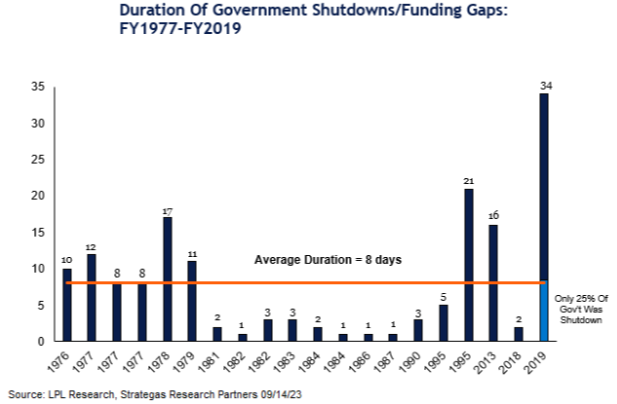
The government has had 20 shutdowns since 1976. The average length of those shutdowns was eight days. The longest, in 2018–2019, lasted 34 days. The chart below, shows the duration of each shutdown since 1976. It is worth noting that the S&P 500 has historically posted average gains of 1.2% and 2.9% in the one- and three-month periods following budget resolutions, underscoring the market’s resilience, though past performance does not guarantee future results. Even if investors ignore the government shutdown, a market pause may be in order given how far stocks have come since April — even as more tariffs are absorbed.
While we might see some ups and downs in the short-term, the bigger picture still looks positive. Rather than getting caught up in the political noise, we believe it’s important to focus on what truly drives the markets. Should a pullback happen, it may present an attractive entry point. Our team is closely following all market signals to make wise and appropriate investment choices.
If you have specific questions or would like to discuss your own investment strategy or financial planning needs, we welcome you to call us at 302.234.5655 or email us at contactus@covenantwealthstrategies.com to set up time to discuss further.
Disclosures:
This material is for general information only and is not intended to provide specific advice or recommendations for any individual. There is no assurance that the views or strategies discussed are suitable for all investors. To determine which investment(s) may be appropriate for you, please consult your financial professional prior to investing.
Investing involves risks including possible loss of principal. No investment strategy or risk management technique can guarantee return or eliminate risk in all market environments. For more information on the risks associated with the strategies and product types discussed please visit http://lplresearch.com/Risks.
References to markets, asset classes, and sectors are generally regarding the corresponding market index. Indexes are unmanaged statistical composites and cannot be invested into directly. Index performance is not indicative of the performance of any investment and do not reflect fees, expenses, or sales charges. All performance referenced is historical and is no guarantee of future results. The Standard & Poor’s 500 Index (S&P500) is a capitalization-weighted index of 500 stocks designed to measure performance of the broad domestic economy through changes in the aggregate market value of 500 stocks representing all major industries.
Unless otherwise stated LPL Financial and the third party persons and firms mentioned are not affiliates of each other and make no representation with respect to each other. Any company names noted herein are for educational purposes only and not an indication of trading intent or a solicitation of their products or services.
All information is believed to be from reliable sources; however, LPL Financial makes no representation as to its completeness or accuracy. Government bonds, notes and Treasury Bills are guaranteed as to the timely payment of principal and interest and, if held to maturity, offer a fixed rate of return and fixed principal value. Bonds are subject to market and interest rate risk if sold prior to maturity. Bond values will decline as interest rates rise and bonds are subject to availability and change in price.
For a list of descriptions of the indexes and economic terms referenced in this publication, please visit our website at lplresearch.com/definitions