

How Are Social Security Benefits Determined?
A question our team often hears from clients is, "How are my Social Security Benefits calculated?"
Understanding how Social Security benefits are calculated can help frame your financial future. The Social Security Administration (SSA) determines your benefit amount based on your Average Indexed Monthly Earnings (AIME) from your highest-earning 35 years. This average calculates your Primary Insurance Amount (PIA), which forms the basis for your monthly benefits.
Calculating Average Indexed Monthly Earnings
To determine your AIME, the SSA adjusts—or "indexes"—your annual earnings to account for changes in general wage levels over time. This process tracks your benefits to reflect the rise in the cost of living and the standard of living during your working years.
From your work history, the SSA selects the 35 years (if you don't have 35 years, Social Security uses 0 for those missing years) with the highest indexed earnings, sums them, and divides the total by the number of months in those years. You need at least 10 years to qualify. This calculation results in your AIME, which is rounded to the nearest dollar.
Understanding Primary Insurance Amount
Your PIA is calculated using a formula that applies specific percentages to different portions of your AIME. These portions are defined by “bend points,” which are dollar amounts that change yearly based on the national average wage index. The bend points for 2025 are set at $1,226 and $7,391.1,2
Let’s imagine your AIME is $13,689 and you retire at 62 in 2025. In this scenario, your PIA would be approximately $4,020.90. However, retiring before your full retirement age results in a reduced monthly benefit—about 30 percent less if you retire at 62. Conversely, delaying retirement increases your benefit, with an 8 percent annual credit for those born after 1942, up to age 70.1,2
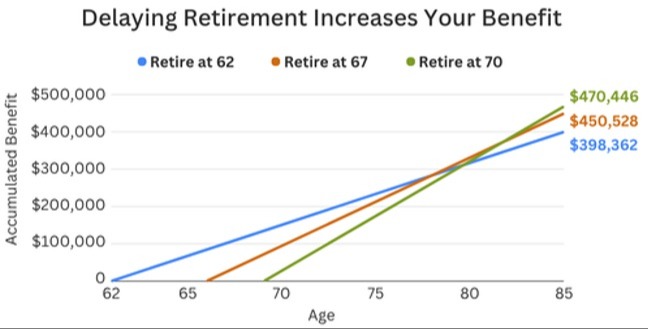
The chart above shows how Social Security benefits accumulate for individuals who started to receive at age 62, 67, and 70. The person who started to receive benefits at age 62 would accumulate $398,362 by the age of 85. Whereas the person who started to receive benefits at age 70 would accumulate $470,446 by the age of 85. The example assumes a retirement benefit of $1,976 at age 67. It does not assume COLA. Source: SSA.gov 2025.
Other Types of Social Security Benefits
In addition to retirement benefits, Social Security provides financial assistance to disabled workers, their families, and survivors of deceased workers. Disability benefits are subject to eligibility criteria and may be adjusted based on the receipt of other public disability benefits, such as Workers' Compensation.
Family members of beneficiaries may also receive benefits; however, the family maximum benefit sets limits on these. Although other calculation methods exist, they are now rarely applied.
We invite you to join us for our upcoming webinar in collaboration with MFS Investments, on the topic of Social Security to learn more.

Social Security - Preparing For Retirement
Thursday, November 6, 2025
4:00 pm ET